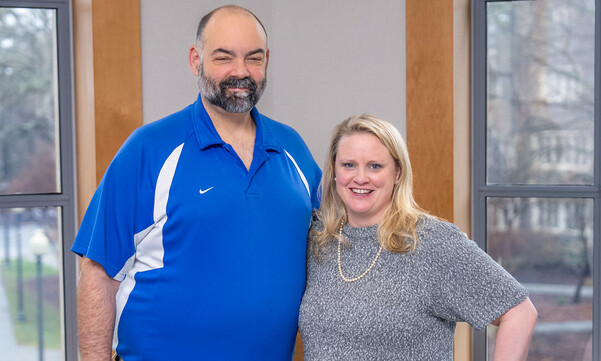
The National Kidney Registry’s voucher program gives people in need of a kidney more ways to receive one and more incentive for people to donate. For Greensboro resident Kimberly Cable, who used the voucher program for her kidney transplant at Duke, it was lifesaving.
A Chronic Condition Leads to Kidney Failure
Cable, 55, is no stranger to Duke Health. She’s been a patient since she was four years old, when she was diagnosed with cystic fibrosis. The condition, which causes damage to the lungs, led her to get a bilateral lung transplant at Duke in 2012 and again in 2015. “Unfortunately, the drugs that keep my body from rejecting my new lungs are also very toxic to my kidneys,” said Cable.
Nearly a decade later, an emergency room visit revealed Cable’s creatinine was almost 10 times higher than normal, indicating kidney failure. “They said there was a fifty/fifty chance I’d have to start dialysis on that admission,” Cable said. Fortunately, she dodged dialysis, but it was time to plan for a kidney transplant.
Donate Now, Transplant Later with a Voucher
Cable’s husband, Kevin Brafford, volunteered to donate a kidney but was disqualified. “They told him that parameters change as people age, so if he had tested even a year earlier, he most likely would have been accepted,” Cable said.
If Cable and her husband knew about the National Kidney Registry’s voucher program earlier, things may have been different. Through the voucher program, her husband could have donated years before, when his kidney was more likely to be accepted. In return for his donation, Cable would have received a “voucher” that she could “redeem” for a kidney when she actually needed it, even if it was years or decades later.
How the Voucher System Works
According to Duke Health nephrologist and kidney transplant specialist Gayle Vranic, MD, the National Kidney Registry’s voucher program started in 2014 when a grandfather wanted to donate a kidney on behalf of his young grandson. “He said, my grandson is going to need a transplant in 10 to 15 years, but I'm already 65 and I can't wait around,” she explained.
The National Kidney Registry accepted the grandfather’s kidney donation and gave his grandson a voucher in return. When the grandson is ready for his transplant, he can redeem that voucher for a living donor kidney transplant at any National Kidney Registry center in the U.S.
To redeem a voucher, the person in need of a kidney will work with their transplant center to be active in the National Kidney Registry, where a pool of available living donors is available for matches. Wait times vary by blood type but average two to six months, much better than the five-year average wait for a deceased donor.
Standard Voucher Versus Family Voucher
The National Kidney Registry offers two types of vouchers: a standard voucher and a family voucher. In Cable’s situation, she received one of each after two friends, Amy Neely and Mack Knotts, wanted to donate. Neither was a direct match, but both were approved to donate and did so through the voucher program.
Neely’s donation resulted in a standard voucher -- when someone donates a kidney for one specific person in imminent need, like Cable. Neely donated in November 2024, and Cable had her kidney transplant in February 2025.
Even though Neely’s donation resulted in Cable exchanging her voucher for a kidney, Knotts still wanted to donate and did so in exchange for a family voucher. A family voucher allows a donor to designate a group of people eligible to redeem it if one of them ever needs it. “Mack’s family voucher includes his immediate family and me,” said Cable.
The family voucher provides peace of mind and extra incentive for people who want to donate but worry about a loved one needing a kidney in the future. For Cable, it gives her options if she needs another kidney in the future. “There's a peace knowing that if this kidney fails, I have another way to go,” said Cable.
Appreciating the Little Things
For now, Cable is enjoying life, feeling grateful for the extra time she gets to spend with her husband, friends, and her two dogs. “It’s about having a choice on how to spend my life. Duke and my friends have given me those choices back,” said Cable.