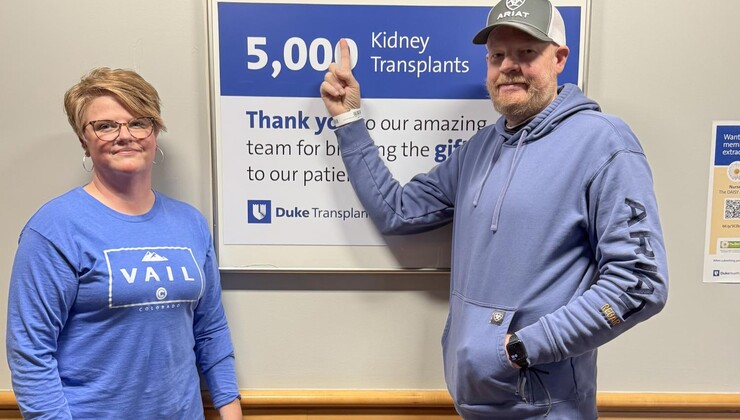
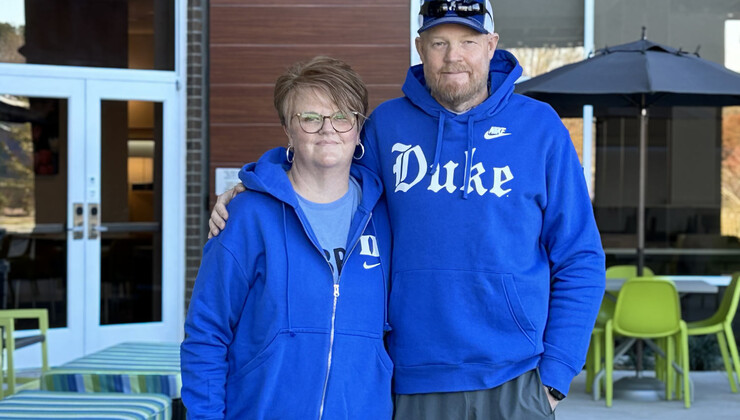
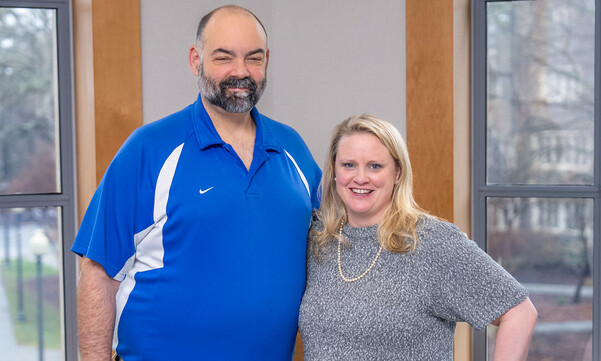
In 2024, Dustin Smith received a life-saving kidney from his sister, but more than one life was changed for the better. Before she donated, Melissa Leatherwood overhauled her lifestyle and lost 60 pounds. Almost a year after his kidney transplant at Duke Health, Dustin is back to hiking and cycling, and Melissa is in the best health of her life. “It feels good knowing I helped her at the same time she helped me,” Dustin said.
No Stranger to Duke
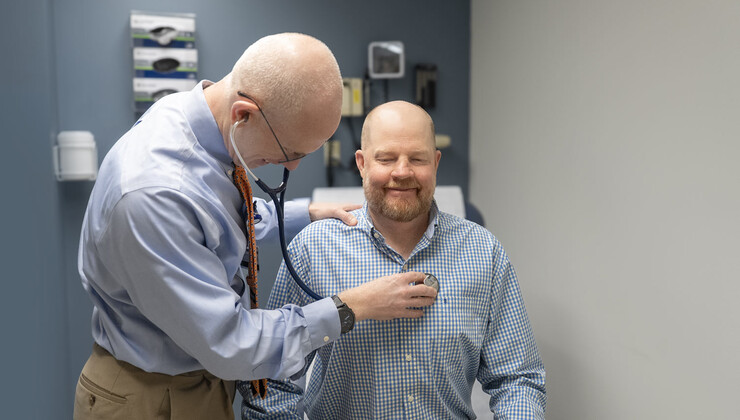
Dustin, 49, has relied on Duke Health for decades despite living over three hours away in Canton. In his early 20s, Duke doctors diagnosed and treated him for granulomatosis with polyangiitis (GPA), a rare vascular disease that causes inflammation in the blood vessels, which eventually damaged his kidneys. “They told me by the time I was 50 I'd probably need a kidney transplant,” said Dustin.
Dustin’s granulomatosis with polyangiitis remained under control, but in 2021 he was diagnosed with a bone marrow disorder called myelodysplastic syndromes (MDS) and myelofibrosis, a rare blood cancer. Again, Dustin chose Duke for his treatment, but the chemotherapy and bone marrow transplant posed another blow to his kidney function. “I knew my time was ticking,” Dustin said. A few years later, doctors told him he would need to start dialysis if he didn’t have a transplant soon.
Looking for a Living Donor
Dustin, a competitive person, made it his goal to beat the doctors’ estimations, watching his diet and implementing exercise to try to avoid dialysis. He knew a living donor was his best bet at getting a kidney sooner, since the average wait time on the national waitlist is about five years. There are other benefits too. “The average living donor kidney lasts around 18 to 19 years versus the average deceased donor, which is 10 to 11 years,” said Duke Health nephrologist Matthew J. Ellis, MD. Overall, kidneys from a living donor are preferred when possible.
Donor Gain and Weight Loss
Dustin’s sister wanted to help, but doctors said she needed to lose weight first. “Weight loss before a transplant can make your recovery faster and easier so it’s often recommended,” said Dr. Ellis.
Melissa, 43, struggled to lose weight most of her life. When she was successful, she’d eventually gain it back. Helping her brother was the motivation she needed to lose the weight and keep it off. “It wasn’t until they told me I needed to be at a certain weight to donate that I really got serious about it,” said Melissa.
Time for Transplant
In eight months, Melissa lost 60 pounds and she and Dustin were ready for the transplant in November 2024. “I didn’t realize how bad I felt until I had the transplant,” said Dustin. “I could tell instantly how well the kidney was working.” Melissa was sore but recovered without complications and was back to work within a few weeks.
Now, nearly a year later, she has maintained her weight loss and healthier lifestyle. She encourages anyone considering kidney donation to get evaluated. “To save someone’s life is worth it. I would do it again in a heartbeat,” Melissa said.
Dustin is back to the active life he loves. He’s training for his first 5K race and biking trails with his wife, Lisa, and Blue Heeler dog, Newt.