Kyle Wilkerson is a classically trained chef who’s always been a “big guy.” By the time he reached his mid-thirties, the 40-year-old former football player weighed more than 300 pounds, and suffered from atrial fibrillation, prediabetes, joint and back pain, and sleep apnea. After meeting his wife, Chelsae, who also struggled to manage her weight, the Roxboro couple had weight loss surgery at Duke Health. Now they are expecting their first child. Getting the surgery was “a complete game changer for us,” he said.
Early Dating Life Revolved Around Eating and Drinking
Chelsae grew up overweight and gained about 50 pounds after her 2019 divorce left her depressed and anxious. When she met Kyle, she entered a world that revolved around eating and drinking. Before she knew it, she weighed 275 pounds.
“I started to feel that depression creep back into my life,” she said. “Eating, socializing, and drinking kept me close to him, but I wasn’t making good choices.”
While Kyle knew people who had successfully undergone weight loss surgery, Chelsae said she thought it was “cheating” and didn’t think she’d be a candidate. “I thought you had to be 500 or 600 pounds to qualify. I know now that isn’t the case.”
Choosing a GLP-1 Before Weight Loss Surgery
The idea of surgery grew on Chelsae after she learned the gastric sleeve procedure could help her manage polycystic ovary syndrome (PCOS). The condition can lead to significant weight gain and impact her ability to have children. She also learned that weight loss surgery could help her manage her hypertension and prediabetes.
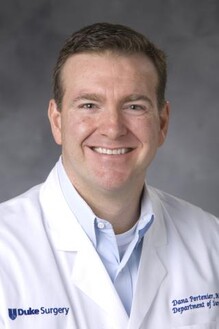
But she still wasn’t ready. After meeting with weight loss surgeon Dana Portenier, MD, at Duke Health, she was prescribed a GLP-1. According to Dr. Portenier, when given under medical supervision, glucagon-like peptide-1 receptor agonists (GLP-1s) can be an effective part of a staged approach to help people reach their weight loss goals.
“My goal was to lose 75 pounds,” Chelsae said, but she stalled at 40 pounds on the medication, despite removing alcohol from her diet, eating better, and exercising regularly. When she decided to move forward with surgery, she said, “I had to prepare much more mentally than I had to prepare my body physically for the changes that were to come.”
Dr. Portenier performed a sleeve gastrectomy on Chelsae in July, 2022. Eventually, she exceeded her weight loss goal, losing 110 pounds. Chelsae still takes medication for her hypertension, but she is no longer prediabetic and has better control of her PCOS.
Obesity-Related Conditions Improve After Surgery
After Chelsae’s surgery, Kyle went to Dr. Portenier for a type of bariatric surgery called Single Anastomosis Duodenal-Ileostomy--SADI for short--in June, 2023. “The day I came home from the hospital, I was able to get rid of my CPAP machine and was off almost half my medications,” he said. He still takes medication to control his blood pressure and atrial fibrillation.
Learning to Cook and Eat Differently
The couple married on May 25, 2024, and continue to be foodies, but they’ve learned to cook and eat differently.
“It’s definitely a mental game of learning how to go to a restaurant and not order like I did when I was 306 pounds,” said Kyle, who now weighs 182. “We go to tapas restaurants and look for smaller plates and different bites.”

Chelsae, 33, agrees. “We haven’t stopped being foodies; we just learned better regulation methods. Now we share the same plate that one of us would have eaten before, and we take some home. It’s three years later, and I still say, ‘Can you believe we used to eat this and then go for dessert?’ It’s wild to think about.”
At home, “We love low country boils,” Kyle said. They focus on eating good proteins like crab legs and shrimp, and less of the carb-heavy potatoes and corn. “I still use andouille,” he said, “but I eat less of it.”
Getting Yourself to Do It Is the Hardest Part
Although he was an advocate for the surgery, Kyle believes the hardest part was “convincing yourself to get started. Getting through that mental block of ‘I can do this. This is for me. I’m not cheating. This is a tool I’m going to use the rest of my life to help me maintain and be where I need to be and make sure I’m better for myself and for my family.’”
Starting Their Family

And that family is growing. While Chelsae thought she “might not ever be able to have kids,” their first baby is due in December, and she feels wonderful. “I haven’t been sick. I’ve had energy. I bet at 300 pounds, I would not have had the same experience.”
While she’s gained back nearly half of her weight while pregnant, she said, “I am happy with where I am considering my circumstances and hope to get back in the swing of things after the baby is born.”