Jessica Clarke was pregnant with her second child when she noticed a small lump in her breast. It grew larger while she waited a month for an ultrasound. After a surgical biopsy confirmed it was a malignant phyllodes tumor, Clarke and her family moved temporarily to Durham so she could have comprehensive cancer treatment and her baby at Duke Health. Today, Clarke is back home in Dallas; her prognosis is good, and her risk of local recurrence is low. “We made it through that,” she said. “We’ll make it through whatever comes next.”
Getting a Second Opinion at Duke Health
Clarke had a lumpectomy in Dallas but started researching her options when her doctors recommended waiting out her pregnancy to see if the tumor would grow back. During a quick Google search, she discovered Duke Health had a team of experts who specialize in phyllodes tumors.
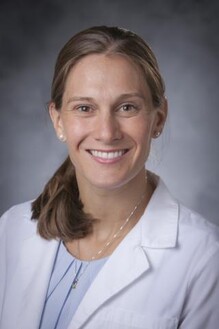
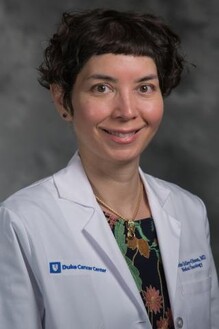
“It felt like the next logical step was to reach out for a second opinion,” Clarke said. After meeting with surgical oncologist Laura Rosenberger, MD, Clarke learned that her tumor was very aggressive and the chance of it recurring was very high. Dr. Rosenberger recommended Clarke undergo a total mastectomy during her pregnancy followed by radiation therapy after she delivered her baby.
Traveling Across the Country for Phyllodes Tumor Care
Back home in Dallas, Clarke, who had just entered her third trimester, discussed with her husband what they should do. The big question was, “How am I going to go to Durham for a mastectomy, then come home and have a baby?” They decided to pack up their five-year-old and two cats and move to a rental in Durham for six months so she could deliver her baby and complete her treatment at Duke.
Dr. Rosenberger said Clarke’s experience isn’t uncommon. “Every week we are seeing women from across the country.” Because phyllodes tumors are more likely to occur in women at younger ages than those with other types of breast cancer, Dr. Rosenberger said her patients include teens, women in their 20s, and women in their childbearing years. Many find Duke online or hear about the team through a private Facebook group for phyllodes tumor survivors.
Duke’s Phyllodes Tumor Team Treats Complex, Complicated Cases
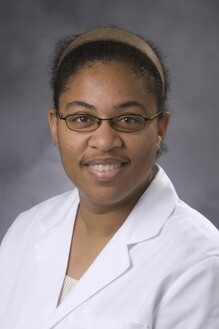
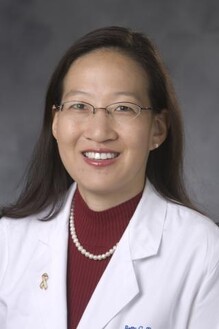
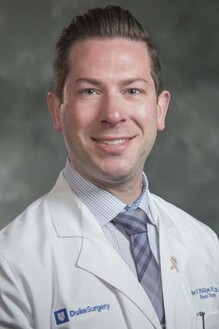
Like Clarke, women come to Duke because its phyllodes tumor specialists have the experience and knowledge to provide complex care. In addition to Dr. Rosenberger, the team includes medical oncologist Juneko Grilley-Olson, MD, radiation oncologist Nicole Larrier, MD, plastic microsurgeon Brett Phillips, MD, and thoracic surgical oncologist Betty Tong, MD. The team also includes physician assistants, nurse practitioners, radiologists, and pathologists, all of whom see and treat this rare tumor regularly.
That depth of experience is difficult to replicate. An individual oncologist, surgical oncologist, or pathologist at another hospital or cancer center may encounter only a few phyllodes tumor cases over the course of their career.
At Duke, Dr. Rosenberger explained, “the team’s repeated exposure to a rare disease creates a level of pattern recognition, clinical judgment, and shared institutional knowledge that grows with every patient. Our team communicates routinely about these patients, approaches challenging cases collectively, and develops individualized treatment strategies.”
Mastectomy, Delivery, Radiation Therapy
Dr. Rosenberger coordinated Clarke’s care with Duke’s maternal fetal medicine team to ensure her mastectomy at 32 weeks went smoothly. Clarke recovered from surgery quickly and delivered her healthy son, Maxwell, during a planned C-section four weeks later. The maternal fetal medicine team then worked closely with Clarke and the phyllodes tumor team to coordinate the start of her radiation therapy.
Supportive Care Gave Clarke’s Family a Sense of Community
Through it all, Clarke and her family adapted to their new life in a strange town. Thanks to Duke's supportive care services, she worked with a therapist provided at no cost and did art therapy to help her cope with the stress and emotional trauma of what she was going through.
Her family also participated in KidsCan!, a support group for children whose parents are going through cancer treatment. “We knew no one, and it gave us a chance to meet other families in similar situations,” Clarke said. “It helped our son and gave us a community feel we wouldn’t have had otherwise.”
Clarke also benefited from physical therapy, which helped her recover from the birth and the surgery. “After my lumpectomy, I was nervous to move my arm, so my mobility became restricted.” Before her mastectomy, she started working with a physical therapist who taught her exercises to get her arm moving safely and position it correctly for radiation.
Clarke and her family are grateful for the time they spent at Duke in Durham. The highlight was being at the Stanley Cup Final when the Carolina Hurricanes bested the Golden Knights. A Las Vegas native, Clarke has always been a Golden Knights fan, but now she has an East Coast team to root for. Being in the area during the post-NHL season, “seemed to weirdly mirror the emotions (highs and lows) of everything happening to us,” she wrote in an email. “Us coming out on the other side of this nightmare and them winning the Cup.”
Participating in Research to Find Answers
While Dr. Rosenberger said Clarke’s prognosis is good and her chance of the tumor returning to her chest wall is low, Clarke will remain under tight surveillance over the next few years to monitor for the tumor recurring in another site in her body.
To help Dr. Rosenberger and her team learn more about phyllodes tumors, Clarke agreed to have her tumor and follow-up reports added to Duke’s growing tumor registry and tumor biorepository studies. “Women like Jessica, who graciously participate in our studies, are vital to advancing our understanding of this rare tumor,” Dr. Rosenberger said.