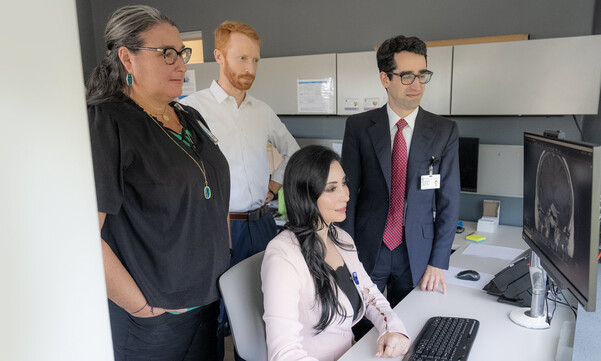
Allegra Austin spent decades searching for a reason behind her complicated medical symptoms, often dismissed by doctors who told her to simply “stop eating” because she was “too fat.” At Duke Health, neuroendocrinologist Leena Shahla, MD, listened to her concerns, ordered tests right away, and diagnosed her with three pituitary disorders caused by two hormone-secreting pituitary tumors, and the tumors were removed a month later. “Because of Dr. Shahla I changed all my doctors to Duke, and now I feel more at ease,” said Austin.
Unexplained Lactation Leads to Pituitary Tumor Diagnosis
Austin, 36, started lactating before she began menstruating. When her period started, it was irregular, and the lactation never stopped. As a young adult, she worked up the courage to see a doctor at her college, but “they said, ‘we don’t really know what’s going on with you, so good luck,’” Austin said.
Eventually her period stopped completely, but the lactation never did, so when she got a job with health insurance, the first thing Austin did was see a gynecologist. She was diagnosed with prolactinoma, a tumor on the pituitary gland that causes excess prolactin, a hormone that signals the body to produce milk. “He told me the tumors are usually non-cancerous, and I could take a medication to make my body go back to normal,” said Austin.
Shortly afterward, Austin moved to North Carolina and had her first child. She attended regular checkups in Wilmington to monitor her prolactinoma. “Things were great until I got pregnant again,” she said.
New Pituitary Tumor Symptoms Appear
During Austin’s second pregnancy, she developed gestational diabetes and experienced rapid weight gain -- more than typical for pregnancy. “I went from 130 pounds to 255 pounds; from a size small to an extra-extra-large” she said.
Austin also developed a hump on her back and started losing her hair. She noticed her hands and feet were growing larger. She had severe acne and felt a strange ache in her bones, and broke her elbow and knee after a minor fall. “Someone my age shouldn't be breaking bones from a simple fall,” said Austin. Plus, she was completely exhausted. “The only way I can describe it is treading water,” said Austin. “You're not quite drowning, but the water is right under your nose and you're just trying to keep up with it.”
When she mentioned it to her primary doctor, “he told me to stop eating, even though I was breastfeeding, and said I was just fat and lazy,” said Austin. Eventually, a different doctor diagnosed her with Cushing’s syndrome and referred her to Duke Health.
Tests Confirm Pituitary Tumors
Austin had her first appointment at Duke Health in July 2025, and lab tests confirmed that she had two hormone-secreting pituitary tumors causing Cushing’s (too much cortisol), hyperprolactinemia (too much prolactin), and acromegaly (excessive growth hormone). “I felt relieved because it confirmed I wasn’t crazy and gave me validation,” said Austin.
When Dr. Shahla reviewed Austin’s past medical records and images, she could see Austin had Cushing’s and acromegaly since at least 2017. “I felt sad and disappointed that nothing had been done for her,” Dr. Shahla said. Unfortunately, it’s not uncommon for pituitary tumors to take years to be diagnosed. “Because we see these conditions every day at Duke, we recognize them much sooner,” said Dr. Shahla.
Compassionate Care Makes a Difference
One month after her initial visit, Duke Health neurosurgeon Patrick Codd, MD, removed both tumors. Her hormones began to normalize, and with time, the other symptoms improved or resolved completely. Austin has been able to discontinue several medications, and she continues to lose weight. “I'm excited about things, which was not something I could say before,” said Austin.
Austin was greatly impacted by the kindness shown to her by Dr. Shahla, and because of that, she switched all her health care providers to Duke Health despite living hours away in Wilmington.
“Patients deserve someone who will listen, understand, and take them seriously,” said Dr. Shahla.