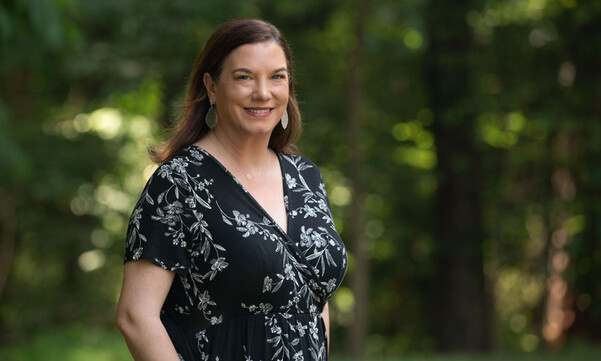
Dave Warthen smoked for 50 years. In September 2025, he joined Duke’s smoking cessation program “Quit at Duke.” And thanks to the team’s expertise and individualized approach, he’s been cigarette-free since March 2026. “Quit at Duke works,” Warthen said, “and I will tell anybody to do it.”
A New Attempt
Dave Warthen, 66, had his first cigarette at 15, and by college, he was smoking up to three packs per day. He tried to quit several times but would get busy or stressed, and the attempt would fail.
A longtime Duke primary care patient, Warthen had heard about Quit at Duke for years. Last September, he saw Duke oncology nurse practitioner Hilary Crittenden for lung cancer screening, and when she mentioned the program, Warthen thought the time was right to give it a try. “I’m a grandfather to a beautiful little girl, and I would never smoke around her, but I thought, ‘Man, I don't want my little Charlee to think of the smell of smoke when she thinks of her grandpa,’” he said.
Customized Approach to Quitting Tobacco
In October 2025, he began meeting virtually with Duke tobacco cessation physician assistant Kelly M. Young. “It was immediately obvious that she’s not marching down a list,” he said. “She is customizing this to me.”
“We look at nicotine dependence, tobacco history, triggers, cues, and any past pharmacotherapy or nicotine substitutes they've used,” explained Young. “That’s what allows us to really individualize care.”
For Warthen, Young recommended a higher dose of nicotine replacement patch than he had used previously, and together they brainstormed behavioral tweaks specific to him. “Every day after work, I sit outside to read and have my beer,” noted Warthen. “It’s an easy way to smoke a lot, so Kelly suggested that I leave my cigarettes all the way at the back of the house.”
Warthen and Young met every few weeks with the goal of decreasing his reliance on cigarettes rather than quitting. The support and the strategies worked, and by the end of February, Warthen was down to three or fewer per day. He smoked his last on March 6 and stopped using the patch in July. “Kelly is my hero,” he said. “She did nothing but cheer me on. When I would take a step backwards, she was right there for me. She would say, ‘You know what? We expect this. It's all right. We go on.’”
The Duke Difference
Young credits the program’s success to Duke’s unrelenting focus on tobacco cessation and access to resources. “Tobacco use disorder is what I do all day,” she said. “We keep up with the latest research, medications, and therapies to really provide the best care. We offer Mindfulness Training for Smokers group classes, and we have a behavioral therapist on staff. We’re able to individualize care to an incredible degree, and get our patients the resources they need.”
Reaping the Benefits of Quitting Smoking
For Warthen, quitting has been a breath of fresh air. “I no longer worry about when and where I'm going to have a cigarette,” he said. “My clothes don’t smell like smoke. Taking a deep breath is a whole different story. I can even tell the difference in my skin.”
“Quitting is about more than not smoking anymore,” said Young. “It's the opportunity for more healthy years, more time with the people you love, and a better quality of life.”
Warthen no longer meets with Young, but he knows she’s just a phone call away. That line is open, stressed Young. “You don’t have to be ready to quit to call,” she said. “We are so open to seeing people who want to just take that first step.”