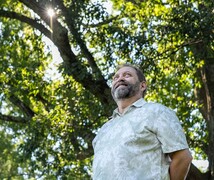
Yvette Crawley, 71, was steadily losing her vision due to a rare, progressive eye disease. For years, no treatment was available. In October 2025, she came to Duke, where she was the first person in the Southeast region to receive a newly approved gene therapy called Encelto™ that should protect her remaining vision. “This treatment allows me to maintain my independence,” Crawley said.
Hope For a Devastating Diagnosis
In 2021, Yvette Crawley of Apex, NC, was diagnosed with macular telangiectasia type 2 (MacTel), a condition that causes slow degeneration or death of light-sensitive cells called photoreceptors in the back of the eye. MacTel leads to gradual loss of vision, especially central vision, which causes difficulties with tasks like driving and reading.
“It was really devastating to hear,” said Crawley. “I just thought, ‘Oh, I live by myself. What's this life going to be?’”
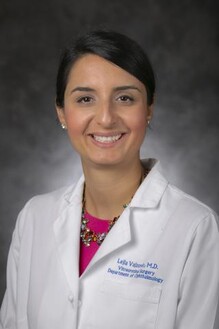
When Crawley returned for her regular checkup at the Duke Eye Center in March 2025, her retinal surgeon, Lejla Vajzovic, MD, told her that a new treatment had been approved by the FDA the day before. A few months later, her eye team asked if she would be interested in receiving it.
“I said, ‘Absolutely! I'm all in. I have 100% confidence in Dr. Vajzovic. I respect her and everything that she does,’” said Crawley.
The New Treatment
Revakinagene taroretcel-lwey (Encelto™) is a cell-based gene therapy capsule. The size of a grain of rice, it contains more than 200,000 living cells within a permeable skin that releases proteins into the retina that keep the photoreceptors healthy.
“One side of it has a little loop,” explained Dr. Vajzovic. “We sew this to the eye wall, and then bury it inside the eye, close off the wound, and cover it with the tissue on the surface of the eye.”
“Unfortunately, this doesn’t reverse the degeneration that’s already happened,” continued Dr. Vajzovic, “but this therapy helps patients retain the vision they do have.”
Adventures Await
“The gift of sight is truly remarkable, and stabilizing that for patients is such a gratifying feeling,” says Dr. Vajzovic. “We know how important vision is in terms of living a fuller, more independent life.”
Crawley concurs. “I'm ready to do some big trips in my RV, like Alaska and the Northern lights,” she says. “I have always had great adventures. Now, I still can.”
Groundbreaking Ideas that Help Patients
Dr. Vajzovic noted that Duke was involved in critical parts of the trial that led to approval of the implant, and to its becoming commercially available. “It’s a perfect example of our mission--Duke researchers working on groundbreaking ideas that directly help Duke patients.”