Sophia Ramirez’s family was told nothing more could be done after two stem cell transplants performed at a hospital near their South Carolina home failed to cure the toddler’s aggressive leukemia. Then her family brought her to Duke Health, where Sophia received a therapy only available through a clinical trial, followed by a third, successful stem cell transplant. Today, the five-year-old is back home, recovering well, and enjoying life with her family. “It was a miracle,” her mother said. “If not for Duke, Sophia wouldn't be here any longer.”
A Difficult Diagnosis and the First Transplant
Sophia Ramirez of North Augusta, SC, was 2 when she was diagnosed with high-risk acute myeloid leukemia (AML) . “The doctors told us it was one of the harder types to treat,” said Sophia’s mom, Karen Campusano Garcia. “My husband and I were devastated.”
Sophia underwent chemotherapy to prepare for a bone marrow transplant, the standard treatment for children with high risk and/or refractory AML. Then her family met pediatric bone marrow transplant specialist Paige DePriest, MD, who was working at a South Carolina hospital at the time. “Immediately after we met her, we knew she would help Sophia, because she was so smart and kind,” said Karen.
Sophia’s medical team determined that her dad would be the best donor, even though he was only a half-match. The bone marrow transplant took place in August, followed by a mandatory 100-day hospital stay. On day 98, tests showed that the cancer had come back.
Second Transplant Fails, Leaving Family with No Hope
“It was so scary,” said Karen. “But Dr. Paige had told us that if that were to happen, we could try to get her back in remission again with chemotherapy and possibly do a second stem cell transplant.” The second transplant, which used peripheral blood stem cells from one of Sophia’s half-match sisters, took place in May 2024.
After the second stem cell transplant, Dr. DePriest left that hospital to join Duke Health. “Dr. Paige was always asking about Sophia,” said Karen. “She would even text me to ask how everything was going.”
Unfortunately, six months after her second transplant, Sophia relapsed again. “I remember her new doctor coming in and saying there’s nothing else we can do for Sophia,” said Karen. “They said we have no other options. All we can do now is take her back home for hospice care.”
A Resolve to Fight
“I just couldn’t believe what I was hearing,” Karen continued. “I was crying because we were not going to give up on Sophia. She had fought so hard. And I remembered how Dr. Paige always said that she would never give up. I came home and reached out to Dr. Paige.”
As soon as I told her, she started calling around for other options, because she thought the same thing we did: We couldn’t just stay home and let her die,” said Karen.
Hope Comes in the Form of a Clinical Trial at Duke
As it turned out, Duke was the only cancer center in the Southeast running a pediatric clinical trial of revumenib, a drug that targets certain types of high-risk, relapsed AML. “Dr. Paige said that there is a low possibility that this could work for Sophia, but at least it’s something. We can try,” said Karen.
Sophia enrolled in the clinical trial in December. “This was a very quick time to enroll in a clinical trial,” noted Dr. DePriest. “It took an entire team at Duke to get insurance approval and complete the transfer, inpatient admission and work-up. It was less than two weeks between when we heard about Sophia’s relapse and when she started the drug.”
Duke Performs Third Transplant with Mismatched Cord
The revumenib, FDA-approved in 2025, worked. “As soon as Sophia’s leukemia went into remission,” said Dr. DePriest, “we had everything lined up and ready to go.”
That meant a third stem cell transplant -- but this one would be different. Sophia’s doctors discussed why her previous transplants may have failed, and what they would do differently. This time, Sophia underwent an unrelated umbilical cord blood transplant, which uses blood collected from a newborn’s umbilical cord. Stem cells from umbilical cord blood, even when mismatched, are less likely than other stem cell types to be rejected by the patient’s body. Because a perfect match was unavailable, the team used a mismatched cord. Mismatched cords add additional complexity and risk to the transplant, and having the expertise to choose the right mismatched cord is critical. Duke is home to leaders in cord blood transplant, with the expertise of pediatric bone marrow transplant specialist Joanne Kurtzberg, MD who played an important role in the cord selection for Sophia. Sophia was transplanted on February 21, 2025.
Sophia also benefited from something called granulocyte donations after her transplant. Dr. DePriest explained: “We used infusions of her dad’s white blood cells to help protect her from infections while we waited for the cord blood to start working. Using the mismatched cord combined with the granulocyte donation gives Sophia the best hope for long-term survival.”
A New Family Member and the Joy of Hair
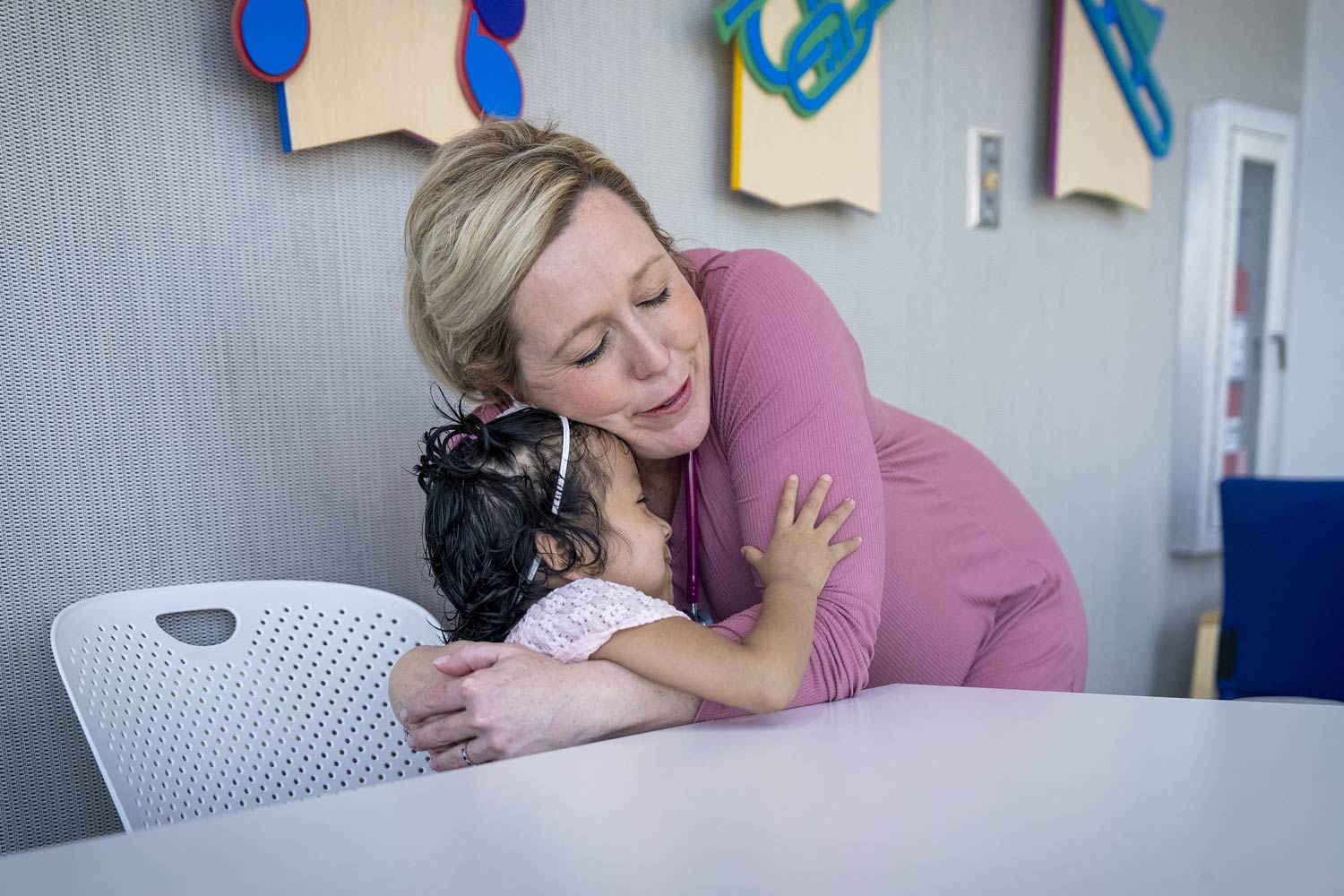
“Everybody at Duke has been so kind,” said Karen. “We go every month for checkups and visit Sophia’s nurses. When Sophia was in the hospital, they would sing to her and paint her favorite princesses on the door. And we consider Dr. Paige a part of our family. We are forever grateful for all the amazing doctors, nurses, and hospital staff who cared for Sophia throughout this journey.”
Dr. DePriest feels the same. “The fact that Sophia is a survivor after a third stem cell transplant is quite miraculous. She's near and dear to my heart,” she said.
Sophia went home in May 2025, and now, over a year after her third transplant, she’s a happy, 5-year-old who loves playing dress up and calls herself ‘Princess Sophia’. “Right now, her little hair is growing back,” said Karen. “Every morning when she wakes up, she's like, ‘Look, Mommy’, and she is so excited.”