Raquel Ferreyra had just separated from her husband and was adjusting to life as a single mother of three teenagers when she was diagnosed with endometrial cancer. After a frustrating experience at a local clinic, Ferreyra contacted Duke and was seen within days. Today she shows no signs of cancer and is thankful for the support she received at the Duke Cancer Center, and from her family and community.
Duke Provides Timely Care After Long Wait Times Elsewhere
When Ferreyra experienced abnormal vaginal bleeding in 2022, she tried to make an appointment at a local clinic. “I had to wait a whole month,” she said. When her appointment finally came, something felt wrong. “The doctor never even opened my chart to see who I was,” she explained. She made an appointment with a gynecologist at Duke Health Holly Springs and had a biopsy and ultrasound the next day.
Ferreyra felt at ease after her biopsy and went back to working as a high school Spanish teacher. On her birthday two days later, during lunch with her daughter, the doctor called and said Ferreyra had endometrial cancer. “She told me, ‘I already scheduled you an appointment at the cancer center in Durham,” said Ferreyra.
Surgery Reveals More Advanced Cancer Than Expected
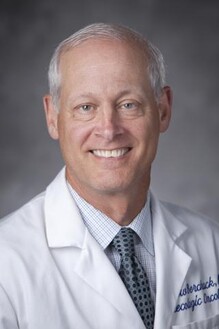
Ferreyra had her first appointment at the Duke Cancer Center with gynecologic oncologist Andrew Berchuck, MD. He explained her cancer would probably only require surgery, like most endometrial cancers. “The expectation was that we would do minimally invasive surgery, get a good report and tell her, ‘You don't need any additional treatment,’” Dr. Berchuck said.
Unfortunately, things were not that simple. Ferreyra tested positive for COVID on the day of her surgery and had to push it back one month. During her surgery, Dr. Berchuck discovered she had stage 3 cancer that had spread to surrounding lymph nodes. “Her case turned out to be not so typical,” said Dr. Berchuck. Following surgery, Ferreyra did six rounds of chemotherapy, then daily radiation treatments for six weeks.
Duke Cancer Support Services Program Was a Lifeline
Despite having no extended family nearby, the native Argentinian said she never felt alone. Her oldest daughter drove her to her appointments, and her son helped her up the steps and to her classroom every day when she felt weak.
Ferreya also found the support her family needed through the Duke Cancer Patient Support Program. Jean Hartford-Todd, CCLS, a child life specialist, "helped me understand how to talk to my kids about my cancer,” she said. Carrie Brown, LMFT, a medical family therapist, “helped me understand the system and what was going to happen through the treatment.” Brown also taught Ferreya breathing exercises so she could "find my inner peace, she said.
Counseling—for herself and her children—was a lifeline. “I never felt alone. I was thankful that there were resources for my kids,” Ferrerya said.
With support from Hartford-Todd and Brown, Ferrerya continued teaching full-time while undergoing treatment for her cancer.
Nurses and staff at Duke helped Ferreyra apply for financial assistance and gathered the paperwork she needed to expedite her mother’s visa so she could travel from Argentina to stay with Ferreyra.
“I felt like I was in the right hands,” she said.
Hear more from Raquel Ferreyra.
A Year After Her Diagnosis Her Scans Are Clear
Once Ferreyra completed chemotherapy and radiation, there was no more evidence of disease. Thinking back to how she felt after that first appointment at her local clinic, Ferreyra is grateful she changed course. She’s thankful for the quick care she received at Duke. “The unknown is the worst part of it, so you want to be seen,” she said. “At Duke, everything went fast – that’s powerful.”