Kathryn Mathews was concerned about lung cancer after she lost her mother to the disease 20 years ago. A CT scan to detect signs of heart disease found a nodule in her lung, and following surgery to remove a malignant tumor, she is on track for a cure, and passionate about lung cancer screening. “I’m going to have a full recovery,” she said. “And I don't take that for granted.”
CT Calcium Score Test Reveals Lung Nodule
Ever since Kathryn Mathews lost her mother when she was 27 to lung cancer, she has wanted to be tested for the disease. But she wasn’t a candidate for screening: The U.S. Preventative Services Task Force recommends it for adults aged 50 to 80 years who have at least a 20 pack-year smoking history, and Kathryn, now 47, is both too young and a non-smoker, as was her mother.
When Mathews’s primary care doctor recommended that she have a CT calcium score test in May 2025 to look for signs of heart disease, she jumped at the chance to have the area imaged. “I knew I had to keep an eye on my lungs,” Mathews said.
Mathews’s heart was fine, but the scan revealed a 1.3-centimeter lung nodule. “My heart just dropped when I heard,” said Mathews. “I am very aware of what that path could look like.”
A Sense of Urgency and a Better Surgical Option
The radiology report recommended a follow-up scan in three months, but Mathews did not want to wait. She scheduled the first available appointment with a pulmonologist, near her home in Summerfield, NC, and once it became clear she would need surgery, pushed for a referral to Duke. “I grew up in North Carolina,” Mathews explained. “Duke’s reputation is stellar.”
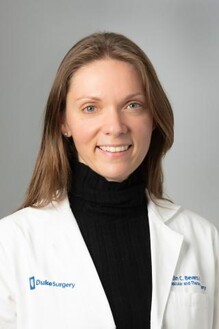
At Duke, Mathews met with thoracic surgeon Kaitlin C. Bevers, MD. Mathews had been told by her pulmonologist that it was likely that she would lose the upper left lobe of her lung. Dr. Bevers offered her something better—a robotic surgery that would remove only a segment of the lung. “Depending on the expertise of the surgeon and the size of the nodule, we can sometimes remove less lung and achieve an equal outcome,” explained Dr. Bevers. “And because it’s minimally invasive, recovery is easier.” Mathews had the surgery on October 9. The tumor was removed, biopsied and found to be stage 1 lung cancer. No further treatment was needed.
Looking Toward the Future
Mathews is following up with regular CT scans, and Dr. Bevers had a sample of the tumor sent for genetic testing. “If Kathryn were to have a recurrence, we want to know what kind of medication would be appropriate for her as soon as possible and potentially save her other aggressive testing,” said Dr. Bevers.
Five and a half weeks after the surgery, Mathews can do most things during the day, but gets winded easily when out for walks in the woods. As an occupational therapist, she hopes that her experience will help her connect with her patients with respiratory challenges. ”I’m looking for ways to put good out in the world from this,” she said.
Dr. Bevers has also helped Mathews get plugged in with advocacy groups like the Lung Cancer Initiative. “I just feel a deep desire to get the story of me and my mom out there. We can get lost in statistics, and it’s important to see the lives that were changed. It is tremendous to me to think that my mom and I could help save somebody's life.”
“Exceptionally good hands.”
Mathews is appreciative of the care she received at Duke. “Dr. Bevers is fantastic,” said Mathews. “She took the time to not only answer my questions, but to sit with me a little bit with the diagnosis, with the treatment plan. I felt I was in exceptionally good hands.”
The irony that Mathews can get a mammogram and a colonoscopy but not the sort of cancer screening that she’s at actual risk of is not lost on her. Dr. Bevers said that expanding screening to include people who aren’t smokers and who have genetic risk is an active area of research. “We’re very aware that this needs to happen,” she said.