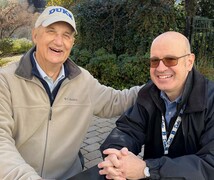
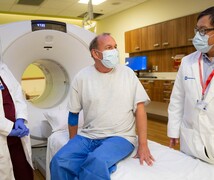
Two decades after Patrick Schultea underwent treatment for prostate cancer, his prostate-specific antigen (PSA) levels began to rise, signaling that the cancer had returned. Because tiny radioactive seeds had been implanted in his prostate at a local hospital to treat his first bout with cancer, Schultea needed a new approach. He found it at Duke Health. Today, he’s back to renovating his beach house and enjoying life with his family.
Overcoming an Initial Reluctance to Radiation Therapy
When Schultea learned his cancer had returned and surgery was not a good option, he was not convinced that radiation therapy was the best next step. “I’d already had radiation, and I was a little reluctant to consider it again. Many people will tell you, you don’t do that twice, especially not when you still have remnants of seeds implanted.”
His thinking changed after meeting with Duke medical oncologist Andrew Armstrong, MD, MSc, and radiation oncologist Paul Koffer, MD. Schultea underwent imaging and a biopsy, which revealed that the cancer had not returned to the prostate, but to the left seminal vesicle, a gland located between the rectum and the bladder.
“It made radiation therapy an option for me,” said Schultea.
A Clear Target on the Enemy
Dr. Koffer recommended stereotactic body radiation therapy (SBRT) -- high-concentration doses of radiation delivered on a specialized linear accelerator. Unlike traditional SBRT, which uses a CT scan to plan the treatment, adaptive SBRT allows doctors to modify radiation plans in real time to account for changes in a patient’s tumor size or anatomy. This is especially valuable when targeting organs like the seminal vesicles, which can move significantly based on the shape and location of the nearby rectum and bladder.
“Adaptive SBRT helps ensure that each treatment is tailored to the patient’s anatomy on the day of treatment, rather than relying on a scan obtained days or weeks earlier,” said Dr. Koffer. “By adapting the treatment plan when the tumor or nearby organs have shifted, we can better protect healthy tissues while maintaining precise targeting of the cancer.” This gives people greater confidence that the intended dose is delivered to the cancer while reducing unnecessary radiation to surrounding organs.
Schulter described it in terms shaped by his military background as a former naval flight officer who flew P-3 Orions and tracked Russian submarines from the air: “There was a term called ‘troops in the open.’ That meant that you had a clear target on the enemy. That’s what this felt like. The cancer cells were in the open and just waiting to get hit.”
Precision Was Critical
Because of the residual seeds from Schultea’s earlier treatment, precision was critical, and the system’s ability to refine the treatment plan in real time allowed the doctors to avoid previously irradiated areas while focusing on the new target.
“That’s the beauty of it,” said Schultea. “They can adapt if they need to. You’re not hitting something you don’t intend to hit, whether that’s healthy tissue or the remnants of seeds. There’s a lot of valuable real estate in that part of the body, and you don’t want to damage it if you don’t have to. This technique lets you be precise, and that makes all the difference.”
Minimal Disruption to Daily Life
Unlike conventional radiation therapy, which can require dozens of treatments over several weeks, Schultea’s course consisted of five sessions lasting about 30 minutes each. There was minimal disruption to his daily life.
“It’s noninvasive, and when you’re done, you’re done,” he said. “I don’t believe I’ve had any side effects from my treatment. If any, they’ve been very mild and consistent from what I still have from the seeds.”
Enjoying Life After Treatment
After completing treatment, Schultea is in a period of watchful waiting. He’s tracking his PSA levels until he completes follow-up imaging -- and he’s living life fully, including taking a recent trip with his wife to the Rock & Roll Hall of Fame in Cleveland, Ohio; renovating his Beaufort, North Carolina beach house that’s been in the family since 1929; and rowing boats as part of the Beaufort Oars Rowing Club.