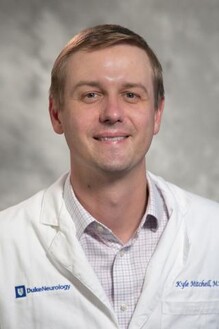
Duke Health was the first center in North Carolina to offer the next generation of deep brain stimulation (DBS) for people with Parkinson’s disease. Called adaptive DBS, this new neurostimulation technology constantly monitors brain activity and automatically adjusts DBS device settings to improve symptom control. “Adaptive DBS allows us to detect abnormal brain signals when a patient is experiencing slowed movements or muscle stiffness and increase brain stimulation to reduce those symptoms,” said Duke neurologist and movement disorder specialist Kyle Mitchell, MD. “The process is completely automated and self-adjusting, like a thermostat.”
The Basics of DBS
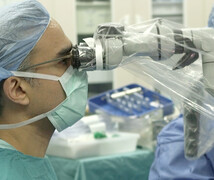
Deep brain stimulation, or DBS, is a well-established treatment for movement disorders like Parkinson’s disease. DBS requires surgical implantation of one or two small electrodes into specific areas of the brain. Wires connect the electrodes to a pulse generator that is placed under the skin in the chest, like a pacemaker. Once activated, the pulse generator sends signals to the electrodes to alleviate abnormal brain activity that contributes to physical symptoms like shaking, slow movements, and muscle stiffness.
Making DBS More Personalized
Traditionally, a neurologist activates your DBS device about a month after your surgery, and uses a computer to manually adjust the device’s stimulation settings based on your brain and symptoms. The goal is to maximize benefit while minimizing side effects like tingling sensations or speech problems. Additional adjustments are made during regular clinic appointments or with a small remote-like device you can use at home. Settings remain fixed between adjustments.
Adaptive DBS automates and personalizes some of the adjustment process. Sophisticated programming monitors electrical signals in the brain. When the device detects brain activity related to slowed movements, for example, it increases stimulation levels temporarily. Studies have shown that adaptive DBS works as well as standard DBS but uses less stimulation, provides more personalized treatment, and may reduce side effects.
Pushing DBS Technology Forward
Duke researchers have been heavily involved in developing adaptive DBS technology, including participating in the pivotal study that led to its FDA approval as well as studies funded by the National Institutes of Health (NIH). Duke experts are also working to improve “imaging-guided DBS,” where specific brain fibers are targeted to treat symptoms that are most disabling to each individual person. Plus, Duke engineers developed new technology that detects unique patterns in people with mobility problems. This technology could help target individual symptoms with personalized deep brain stimulation.
“Parkinson’s impacts people in such different ways, and there is no one-size-fits-all treatment,” said Dr. Mitchell. “At Duke, we have been at the forefront of improving DBS. Collaborations among experts in neurology, neurosurgery, and biomedical engineering allow us to continue advancing this life-changing technology.”