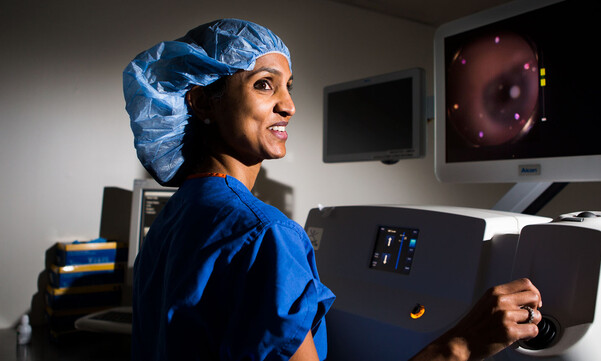
Chances are, you know someone who has had LASIK surgery, or you may have considered the procedure yourself. Despite the allure of ditching daily eyewear, the decision to undergo this elective surgery is one most people understandably deliberate on for quite a while. Here, Duke corneal specialist Kourtney Houser. MD, explains what you need to know if you are considering LASIK surgery.
Is LASIK as quick, easy, and painless as it's sometimes described?
Make no mistake -- LASIK is surgery, and anyone who implies otherwise is not forthcoming.
The surgeon creates a flap in the cornea, and a laser is used to reshape the underlying cornea. The surgery takes less than ten minutes, and patients feel pressure but no pain.
However, that does not mean it is a simple procedure that just anyone can perform. Like any surgery, the experience of the surgeon is the most important factor in achieving the best results.
What factors are important when considering LASIK?
In addition to the surgeon's experience, several elements are crucial to success with LASIK surgery. It starts with a thorough preoperative exam by a qualified surgeon and staff to ensure you are a good candidate.
The quality of the surgical tools, such as the laser used, is also very important. We believe that having dedicated, on-site laser machines in a controlled operating room environment, where temperature and humidity are constantly monitored, contributes to better outcomes in our patients.
We also have two different excimer laser platforms so that we can customize the procedure to each patient’s eye measurements and ensure the best vision possible.
What complications are possible, and how common are they?
Any eye procedure has a risk of vision loss, infection, or scarring, but thankfully this is very rare with LASIK. We actually think that the infection risk is less than that with contact lens wear over a patient’s lifetime, based on some reviews.
Other risks include needing a second procedure, worsened dry eye, and development of pain or discomfort in the eyes, but most of these can be avoided by appropriate and in-depth pre-operative screening.
Our rate of complications is extremely low, with the majority of them occurring less than 1% of the time. Our rates of enhancement (the need for additional laser adjustments) are under 2%.
Who is not a good candidate for LASIK?
Good question. There are people who are not candidates for LASIK surgery. In fact, I generally turn down roughly 20% of the prospective patients who come in for an evaluation.
Some of the more common reasons include high refractive errors (nearsightedness or farsightedness), dry eyes, thin or abnormally shaped corneas, cataracts, and retinal problems from diabetes.
The good news is that if you do not qualify for LASIK, Duke offers an array of alternative surgical procedures, such as PRK, phakic intraocular lenses, and cataract surgery with presbyopia- or astigmatism-correcting intraocular lenses.
How long do improvements last?
Improvements typically last a lifetime, though there can be some slight regression with time depending on your prescription. Also, most patients will develop a need for reading glasses as they reach their 40s and 50s--and while this doesn’t signify the LASIK “not working” anymore, it does usually require patients to wear glasses for some near tasks.
What's the bottom line when considering LASIK?
LASIK is not for everybody, but those who are good candidates can experience a life-changing experience--independence from glasses or contact lenses and the freedom to see without correction for many years.
As with any surgery, people should do their homework beforehand and choose a surgeon and facility in which they have confidence.